Deer Season Is Starting: Why the Next Ten Weeks Are the Riskiest Time to Drive at Dusk
September marks the start of deer season on American roads, when rut behavior and shifting daylight combine to spike collision risk through November. Here's what actually reduces your odds, and what your insurance policy won't volunteer upfront.
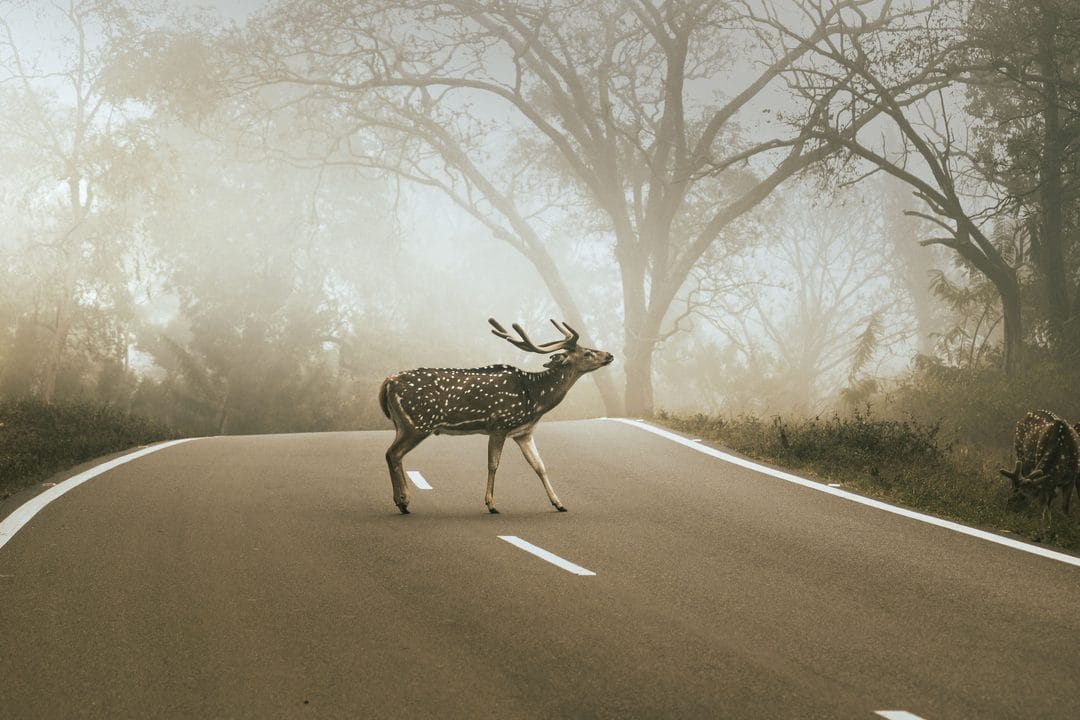
Somewhere around the second week of September, without any signal beyond a shift in daylight, the odds of putting a deer through your windshield start climbing. Insurers see it every year in their claims data, state wildlife agencies track it in roadkill counts, and most drivers never notice until the morning commute suddenly overlaps with sunrise instead of trailing behind it. The rut — the whitetail breeding season that pushes deer to move constantly and think about almost nothing else — kicks off in early autumn and peaks through October and November, and it turns ordinary two-lane roads into something closer to a moving obstacle course at dawn and dusk.
This isn't a niche problem confined to rural back roads. Somewhere in the range of 1.5 to 2 million deer-vehicle collisions happen on US roads every year, and the real number is almost certainly higher because a lot of low-speed hits never get reported to police or an insurer. In the handful of states that consistently post the worst odds in the country, an average driver's annual chance of a strike runs close to 1 in 40; Montana, Michigan, Pennsylvania, and Wisconsin all sit near that top tier. Average claim cost per incident tends to land somewhere between $4,000 and $5,000 once you account for a cracked radiator support, a bent hood, and the sensors packed behind every modern bumper. A handful of those crashes turn fatal every year too, almost always because a driver swerved into oncoming traffic or off the road entirely rather than hitting the animal head-on. That's the detail state troopers mention every autumn and drivers forget every spring, right up until the next windshield gets cracked.
Why the Odds Flip in September
Two things happen at once, and neither one is obvious from behind the wheel. First, deer physiology shifts — bucks start actively seeking does, yearlings get pushed out of their home territory by more dominant animals, and the whole population becomes far more mobile than it was in July or August, when deer mostly stick to a tight, predictable range. Second, and this is the part drivers underestimate, the clock and the calendar stop matching up. Commute times that used to fall in full daylight now overlap with the last hour of dusk, which happens to be exactly when deer move most. You're not driving worse. You're driving into a window you weren't in a month ago.
Late October through late November is genuinely the worst stretch — that's peak rut in most of the continental US — but September deserves attention precisely because drivers aren't expecting it yet. Nobody's guard is up. The trees still have leaves, temperatures are mild, and the seasonal mental shift toward "deer season" hasn't happened for most commuters the way it has for hunters, who've been tracking rut timing on an app since Labor Day.
Where You're Most Exposed
Speed and road type matter more than most drivers assume. A 2-lane rural highway posted at 55 mph with agricultural fields or woodland on both sides is worse than either a slow residential street or a divided interstate with a center barrier — the deer has room to build speed before it enters your lane, and you don't have the reaction distance a lower-speed road gives you. Roads that run parallel to a tree line, cross a creek, or sit near any kind of agricultural edge concentrate deer traffic because that's exactly where deer feed and bed down.
Insurance industry data on state-by-state risk isn't perfectly consistent year to year, but the same handful of states show up near the top every cycle:
- Montana and South Dakota, where open range and low traffic density push the odds up close to 1 in 40 for an average driver
- Michigan, where suburban sprawl now runs directly into deer wintering grounds and the collisions have followed the housing developments
- Pennsylvania, Wisconsin, and Iowa round out most annual top-ten lists, among others
If you're driving through farm country or dense forest in any of those states between now and Thanksgiving, treat every rural two-lane road after 6 p.m. as a higher-alert zone, not just the ones with a yellow deer-crossing sign. Those signs mark historically documented crossing points, but deer don't read them, and the absence of a sign means nothing about the absence of deer.
What Actually Reduces Your Odds
Deer whistles — the little plastic devices marketed to mount on your bumper and emit an ultrasonic tone that supposedly scares deer off the road — don't hold up under independent testing. Multiple wildlife agencies, including several state DOTs, have tested them and found no measurable reduction in collision rates. Skip them. What actually works is boring, cheap, and mostly a matter of discipline: use your high beams on any unlit rural road whenever there's no oncoming traffic, because they roughly double your visible distance and give you two or three extra seconds to react — which, at 55 mph, is the difference between a hard brake and a full-speed hit.
Scan the road edges, not just the road itself. Deer eyes reflect headlights distinctly, and a driver who's actively sweeping the shoulder and tree line ten to fifteen car-lengths ahead will spot that reflective glint well before a driver staring only at the centerline does. Deer rarely travel alone during rut season — if one crosses, assume at least one more is behind it, often seconds later, and don't relax the moment the first one clears your lane.
And here's the recommendation most safety pamphlets soften but shouldn't: if a collision is unavoidable, brake hard and stay in your lane. Don't swerve. Swerving to avoid a deer is what puts drivers into oncoming traffic, a tree, or a rollover, and the injury statistics from swerve-related crashes are consistently worse than the statistics from a direct, low-speed impact with the animal. A deer hit while you're braking straight tends to total a bumper and a headlight. A swerve into the opposing lane tends to total the car and, depending on what's coming the other way, a lot more than that. Motorcyclists face the sharpest version of this trade-off, since there's no bumper to absorb the hit and a low-side drop at speed is its own separate hazard — but the core instinct is the same for two wheels or four: brake, don't steer away. It's the single piece of advice state troopers repeat every fall and the one drivers ignore in the half-second panic of headlights hitting a set of eyes in the dark.
The Insurance Question Nobody Answers Until the Claim
Hitting a deer is a comprehensive claim, not a collision claim — that distinction matters because comprehensive coverage typically carries a lower deductible and, in most states, doesn't trigger the same rate increase that an at-fault collision does. If your policy only carries collision coverage without comprehensive, an animal strike may not be covered at all, which is a gap a surprising number of drivers discover only after the tow truck shows up. Check your declarations page this week, not after the fact — it takes five minutes and it's the cheapest insurance research you'll do all year.
The catch that insurers won't lead with in their marketing: comprehensive claims for animal strikes generally don't raise your premium the way an at-fault accident does, but a second or third claim within a short window can still trigger a "claims frequency" review that pushes your rate up regardless of fault. One deer strike in three years is a rounding error to most insurers. Three in three years starts to look like a pattern they price for, even though none of it was your fault in any meaningful sense.
After You've Hit One
Pull well off the roadway if the car is still drivable — a stalled car on a dark rural road is now a second hazard on top of the first. Don't approach an injured deer; a startled animal with functioning legs can do real damage with a kick, and the safest move is to call local animal control or the state wildlife agency's non-emergency line rather than handling it yourself. Photograph the damage before you drive another mile, including anything behind the grille if the impact was hard enough to push the radiator or condenser back — a five-minute phone-camera pass now saves an argument with an adjuster later about whether that AC failure two weeks from now was actually related.
File the claim the same day if you can, even for damage that looks minor. Airbag sensors, radar-based cruise control modules, and parking sensors all live behind bumpers and grilles, and a strike hard enough to crack a headlight housing is often hard enough to knock one of those out of calibration without leaving a visible mark. A body shop that only fixes what's visibly bent will hand the car back with a warning light nobody explains, and that's a conversation worth having with the adjuster up front rather than three weeks after the repair is closed out.
None of this turns a two-lane road through farm country into something to avoid. It just means the next ten weeks reward the driver who treats dusk on a rural highway as a different kind of driving than noon on the interstate — slower, more scanned, headlights up whenever the road allows it. That's the whole adjustment, and it's the one most drivers make about three weeks too late every single year.