Reading OBD2 Codes at Home: What the Check Engine Light Actually Means Before You Pay a Garage
An amber light on the dash doesn't have to mean an immediate trip to the garage. Here's how to plug in a cheap scanner, read the code yourself, and work out whether it's urgent or just noise.
The light comes on somewhere between junction 14 and 15 of the M6, right as you're overtaking a lorry in the rain. Nothing about the car feels different — no smell, no noise, no drop in power. Just that small amber engine icon, glowing on the dash for the rest of the drive home, quietly ruining your evening. Most drivers in that situation do one of two things: ignore it and hope, or book the first available slot at a garage and brace for a bill.
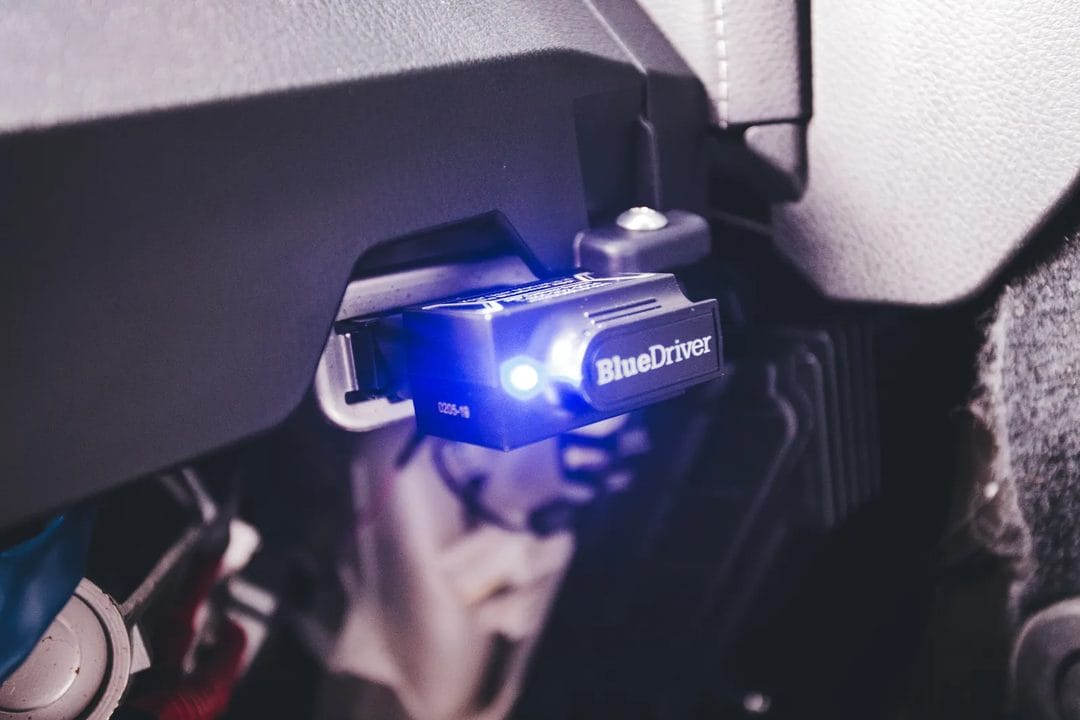
There's a third option, and it takes about ten minutes. Every petrol or diesel car built since 2001 (2003 for some diesels) has an OBD2 port under the dashboard, usually within reach of the driver's knee, and that port will tell you exactly why the light came on if you ask it the right way. You don't need a mechanic's toolkit or any real technical knowledge — you need a scanner that costs less than a tank of fuel and about ten minutes before you decide whether this is a garage job or something you can sort yourself.
What the check engine light is actually reporting
The engine management system in a modern car monitors dozens of sensors continuously — oxygen levels in the exhaust, fuel trim, misfires, coolant temperature, evaporative emissions, the lot. When a reading falls outside its expected range for long enough, the system logs a fault code and lights the amber engine icon. That's it. The light itself carries no information beyond "something logged a fault" — it's the code behind it that actually tells you anything useful, and that code only lives in the car's memory until you retrieve it.
This is where people go wrong at the garage. A lot of independent workshops will plug in a scanner, read the code off the screen, and charge a diagnostic fee of £40–£90 for information that took the machine eight seconds to produce. That's not a scam exactly — reading the code correctly and knowing what it actually means for your specific engine does take skill, and garages are pricing their expertise, not the plug-in. But for a huge share of common faults, you can do the first step yourself and walk in already knowing what you're dealing with, which changes the conversation entirely.
Getting a scanner: what's actually worth buying
You have three realistic options, and the price gap between them is enormous for very little difference in what most drivers need.
- A Bluetooth ELM327 dongle (£10–£18 on Amazon or eBay) that plugs into the OBD2 port and pairs with a free app on your phone — Torque, Car Scanner ELM327, or OBD Auto Doctor all work fine on this hardware
- A dedicated handheld scanner from Autel or Launch (£50–£120), which reads faster, doesn't rely on your phone's Bluetooth being cooperative, and usually gives a plain-English description alongside the code
- The free check some chains offer — Halfords and most Euro Car Parts branches will read your code for nothing if you buy so much as a bulb while you're there
Buy the cheap Bluetooth dongle. Unless you're planning to do this regularly across several vehicles, a £15 ELM327 tells you exactly the same code as a £120 Autel unit, and the app translates it into readable English either way. Save the money and put it toward whatever the fix actually turns out to be.
Codes that matter, and codes that don't
Fault codes follow a standard format — a letter, then four digits, like P0420 or P0171. The "P" means powertrain, and that's the category you'll see most often. Once you've pulled the code, the temptation is to treat every result as equally urgent. It isn't.
P0420 / P0430 — Catalytic converter efficiency below threshold. This one shows up constantly on cars past 80,000 miles and it's rarely an emergency the day it appears, though it will eventually fail an MOT emissions test if ignored. A worn cat, a lazy oxygen sensor, or even a small exhaust leak upstream can all trigger it. Get it checked before your next MOT is due, not necessarily tonight.
P0300–P0308 — Random or cylinder-specific misfire. This is one you don't sit on. A misfire dumps unburned fuel into the catalytic converter, which can cook it within days of sustained driving, turning a £40 spark plug job into a £600 catalytic converter replacement. If the code is P0300–P0308 and the light is flashing rather than steady, stop driving and get it looked at that day — a flashing light specifically means the engine computer sees an active misfire happening right now.
P0171 / P0174 — System too lean. Usually a vacuum leak, a dirty mass airflow sensor, or a failing fuel pump. Not urgent in the next hour, but it will hurt your fuel economy noticeably — drivers often report 10–15% worse mpg — so it's worth sorting within the week rather than letting it become background noise.
P0455 — Evaporative emissions system leak, large. Check your fuel cap first. Genuinely — a loose or cracked fuel cap is the single most common cause of this code, and it costs about £8 to replace at any parts shop. Tighten it, clear the code, and see if it comes back before you assume anything more serious.
P0128 — Coolant thermostat below regulating temperature. Not dangerous on its own, but it means your engine is running cooler than designed, which increases wear over time and can trip the check-engine light every cold morning until the thermostat is replaced — a £60–£120 job at most independents.
Clearing the code isn't fixing the problem
Every scanner, cheap or expensive, has a button that clears the stored code and turns the light off. Resist the urge to press it before you've actually addressed whatever triggered it. The underlying fault is still there — you've only wiped the memory of it, and the light will come back once the same sensor trips the same threshold again, usually within a few drive cycles. Clearing the code without fixing anything is occasionally useful for one specific reason: ruling out a one-off glitch, like a fuel cap that wasn't seated properly. If the same code reappears within a day or two of driving, that's your confirmation the problem is real and not a sensor having a bad moment.
There's a genuine grey area here worth being honest about — some codes really are sensor faults rather than mechanical ones, and the sensor itself can be more expensive to replace than the part it's meant to monitor was ever worth fixing. An oxygen sensor on some German models runs to £150 fitted, purely for a component that reports on emissions rather than affecting how the car drives. In those cases, plenty of experienced owners will tell you honestly that living with the light on, once you know exactly what it means and that it's not a safety issue, is a defensible choice — it just won't pass an MOT.
Generic codes versus manufacturer codes
Not every code in the system is created equal, and this trips people up more than the codes themselves. A "generic" P0-series code is standardised across every manufacturer — a P0420 means the same thing on a Ford Fiesta as it does on a BMW 3 Series, because the SAE (the standards body behind OBD2) mandates it. But plenty of cars, particularly VAG group models (VW, Audi, Skoda, SEAT) and most BMWs, also throw manufacturer-specific codes starting with P1, P2, or P3 that a basic £15 dongle will read as raw numbers without a description. Torque and Car Scanner ELM327 both maintain community-sourced lookup databases for these, so before you assume the app is broken because it's shown you "P1055" with no explanation, search the code with your car's make in the query — someone on a VW owners' forum has almost certainly hit the exact same number.
Live data is the other thing a decent app gives you beyond the stored code, and it's worth understanding because it's how you tell a real fault from a fluke. Once you're connected, most apps let you watch the actual sensor readings in real time — short-term and long-term fuel trim, oxygen sensor voltage swinging between roughly 0.1V and 0.9V as it should, coolant temperature climbing to its normal 88–105°C operating range. If a P0171 lean code shows up but your fuel trims sit close to zero once the engine's warm, you're likely looking at a code that logged once during a cold start and never repeated — not something to chase urgently. If the trims are sitting at +20% or higher, that's a genuine vacuum leak or failing sensor, and the code was accurate the first time.
When the scanner isn't enough
A code points you toward a system, not always toward the exact failed component. P0300 tells you there's a misfire; it doesn't tell you whether that's a spark plug, a coil pack, a dying injector, or low compression from a worn valve. For anything involving fuel delivery, timing, or a code you don't recognise from the common list, that's the point to take the printout to a garage rather than start swapping parts on a guess. Kwik Fit, Halfords Autocentres, and most independents will happily start from your code reading rather than charging you again for the diagnostic step — walking in with the code already in hand routinely saves that £40–£90 fee outright.
Codes involving the airbag or ABS systems don't come through the standard OBD2 powertrain scan on most budget dongles at all — those need a scanner with the extra body and chassis modules enabled, which the £15 units generally don't have. If your dash shows an airbag or ABS warning alongside or instead of the engine light, that's not a ten-minute driveway job regardless of how good your scanner is.
Keep the scanner in the glovebox once you've got one. The next amber light — and on a car with more than 60,000 miles, there will be a next one — costs you ten minutes and the price of the fuel cap you probably needed anyway, instead of an afternoon wondering what's wrong and a diagnostic fee for the privilege of finding out.